Do you want to see and set it?
The Smart Active Balancer is the only line with Bluetooth, live cell voltages and an app-set balance current. It also cascades past 24S over a TTL bus.

Selection guide
Four questions decide it: how many cells in series, how much current you can afford to move, whether you want to control it from a phone, and whether the pack can spare a few milliamps of standby draw.
The Smart Active Balancer is the only line with Bluetooth, live cell voltages and an app-set balance current. It also cascades past 24S over a TTL bus.
A smart balancer draws roughly 0.5 W continuously and needs a supply. Capacitor and inductor boards run purely on the pack and idle at 7–18 mA and 10 µA respectively.
Order the lines by current: inductor 2 A peak, capacitor 5.5 A peak, smart balancer up to 15 A constant. A 2 A transfer closes a 3 Ah cell gap overnight; 15 A does it in an afternoon.
Chemistry, series count and pack capacity are enough — the finder ranks every compatible model and says why the rest were ruled out. Or send us the numbers, including how long a cell has been drifting, and we will reply with a model, a current setting and a wiring diagram — usually within one working day.
| Bleeder resistor (passive) | NEEY active balancing | |
|---|---|---|
| Where the energy goes | Burned as heat at the strongest cell | Moved into the weakest cell |
| Typical current | 0.05 A – 0.2 A | 2 A – 15 A depending on line |
| Heat in the pack | Yes — adds to thermal load | Negligible |
| Large packs | Cannot close a gap measured in Ah | Designed for 30 Ah – 300 Ah |
| Visibility | None | Live cell voltages, currents and temperature |
| Cost | Lowest | Higher board cost, offsets in pack lifetime |
App-controlled, supercapacitor transfer, adjustable constant current. All four models share the same firmware feature set — you are choosing current and board size.
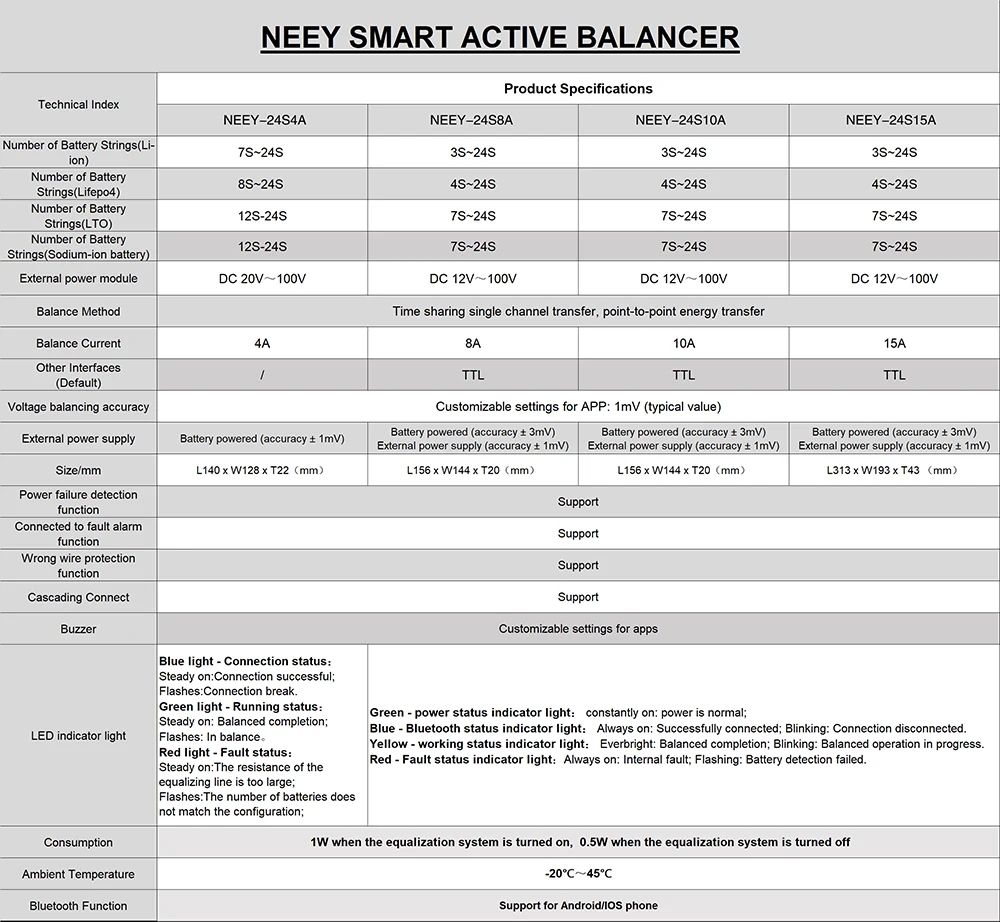
| Model | Balance current | Cell count | Power input | TTL bus | Dimensions | Weight |
|---|---|---|---|---|---|---|
| NEEY-24S4A | Adjustable in app: 1 A – 4 A | Li-ion 7S–24S · LiFePO4 8S–24S · LTO 12S–24S · sodium-ion 12S–24S | DC 25 V – 100 V, or battery powered | Not available on this model | L140 × W128 × T22 mm | 247 g (board) · 470 g (packed) |
| NEEY-24S8A | Adjustable in app: 1 A – 8 A | Li-ion 3S–24S · LiFePO4 4S–24S · LTO 7S–24S · sodium-ion 7S–24S | DC 12 V – 100 V, or battery powered | Yes — 115200 baud, 8N1, master–slave protocol | L156 × W144 × T28 mm | 810 g (packed) |
| NEEY-24S10A | Adjustable in app: 1 A – 10 A | Li-ion 3S–24S · LiFePO4 4S–24S · LTO 7S–24S · sodium-ion 7S–24S | DC 12 V – 100 V, or battery powered | Yes — 115200 baud, 8N1, master–slave protocol | L166 × W157 × T26 mm | 810 g (packed) |
| NEEY-24S15A | Adjustable in app: 1 A – 15 A | Li-ion 3S–24S · LiFePO4 4S–24S · LTO 7S–24S · sodium-ion 7S–24S | DC 12 V – 120 V, or battery powered | Yes — 115200 baud, 8N1, master–slave protocol | L313 × W193 × T43 mm | 2530 g |
Whole-pack simultaneous balancing with no external supply and no configuration. One board covers a range of cell counts — the “supports” column is what a single board can be wired to.
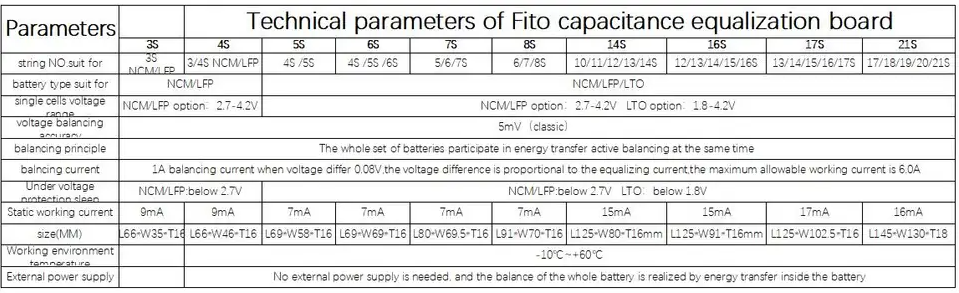
| Model | Supports | Standby current | Dimensions | Weight |
|---|---|---|---|---|
| EK-C3S5A | 3S | 9 mA | L66 × W35 × T16 mm | 45 g |
| EK-C4S5A | 3S / 4S | 9 mA | L66 × W46 × T16 mm | 55 g |
| EK-C5S5A | 4S / 5S | 7 mA | L69 × W58 × T16 mm | 70 g |
| EK-C6S5A | 4S / 5S / 6S | 7 mA | L69 × W69 × T16 mm | 85 g |
| EK-C7S5A | 5S / 6S / 7S | 7 mA | L80 × W69.5 × T16 mm | 95 g |
| EK-C8S5A | 6S / 7S / 8S | 7 mA | L91 × W70 × T16 mm | 105 g |
| EK-C10S5A | 8S / 9S / 10S | 15 mA | L114 × W70 × T16 mm | 130 g |
| EK-C12S5A | 9S / 10S / 11S / 12S | 15 mA | L137 × W70 × T16 mm | 160 g |
| EK-C14S5A | 9S / 10S / 11S / 12S / 13S / 14S | 15 mA | L125 × W80 × T16 mm | 180 g |
| EK-C16S5A | 12S / 13S / 14S / 15S / 16S | 15 mA | L125 × W91 × T16 mm | 205 g |
| EK-C17S5A | 13S / 14S / 15S / 16S / 17S | 17 mA | L125 × W103 × T16 mm | 225 g |
| EK-C21S5A | 17S / 18S / 19S / 20S / 21S | 18 mA | L145 × W130 × T16 mm | 250 g |
Adjacent-cell transfer through a matrix transformer. Sorted by weight, which is usually the constraint on small packs.
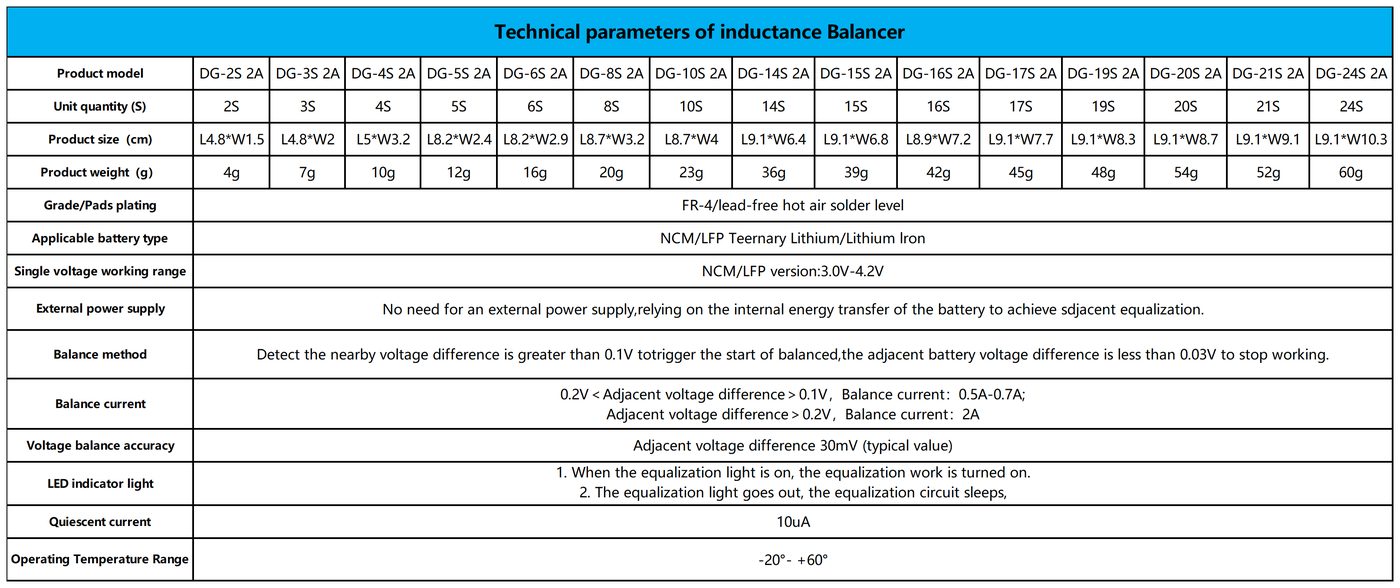
| Model | Cell count | Peak current | Accuracy | Dimensions | Weight |
|---|---|---|---|---|---|
| DG-2S 2A | 2S | 2 A | 30 mV neighbour delta (typical) | L48 × W15 mm | 4 g |
| DG-3S 2A | 3S | 2 A | 30 mV neighbour delta (typical) | L48 × W20 mm | 7 g |
| DG-4S 2A | 4S | 2 A | 30 mV neighbour delta (typical) | L50 × W32 mm | 10 g |
| DG-5S 2A | 5S | 2 A | 30 mV neighbour delta (typical) | L82 × W24 mm | 12 g |
| DG-6S 2A | 6S | 2 A | 30 mV neighbour delta (typical) | L82 × W29 mm | 16 g |
| DG-8S 2A | 8S | 2 A | 30 mV neighbour delta (typical) | L87 × W32 mm | 20 g |
| DG-10S 2A | 10S | 2 A | 30 mV neighbour delta (typical) | L87 × W40 mm | 23 g |
| DG-14S 2A | 14S | 2 A | 30 mV neighbour delta (typical) | L91 × W64 mm | 36 g |
| DG-15S 2A | 15S | 2 A | 30 mV neighbour delta (typical) | L91 × W68 mm | 39 g |
| DG-16S 2A | 16S | 2 A | 30 mV neighbour delta (typical) | L89 × W72 mm | 42 g |
| DG-17S 2A | 17S | 2 A | 30 mV neighbour delta (typical) | L91 × W77 mm | 45 g |
| DG-19S 2A | 19S | 2 A | 30 mV neighbour delta (typical) | L91 × W83 mm | 48 g |
| DG-20S 2A | 20S | 2 A | 30 mV neighbour delta (typical) | L91 × W87 mm | 54 g |
| DG-21S 2A | 21S | 2 A | 30 mV neighbour delta (typical) | L91 × W91 mm | 52 g |
| DG-24S 2A | 24S | 2 A | 30 mV neighbour delta (typical) | L91 × W103 mm | 60 g |
Coils, auxiliary contacts, lead lengths and terminal hardware are configurable on every contactor — see each product page for the ordering code.